China's EV export future
China’s vehicle-export boom is becoming a structural outlet for an industry rapidly electrifying at home and turning against foreign combustion-engine brands. The change is especially stark for Japanese carmakers, whose China sales are collapsing as buyers shift to cheaper, better-equipped domestic EVs and plug-in hybrids. Their historic strengths in petrol engines and conventional hybrids carry less weight in a market defined by batteries, software and aggressive pricing.
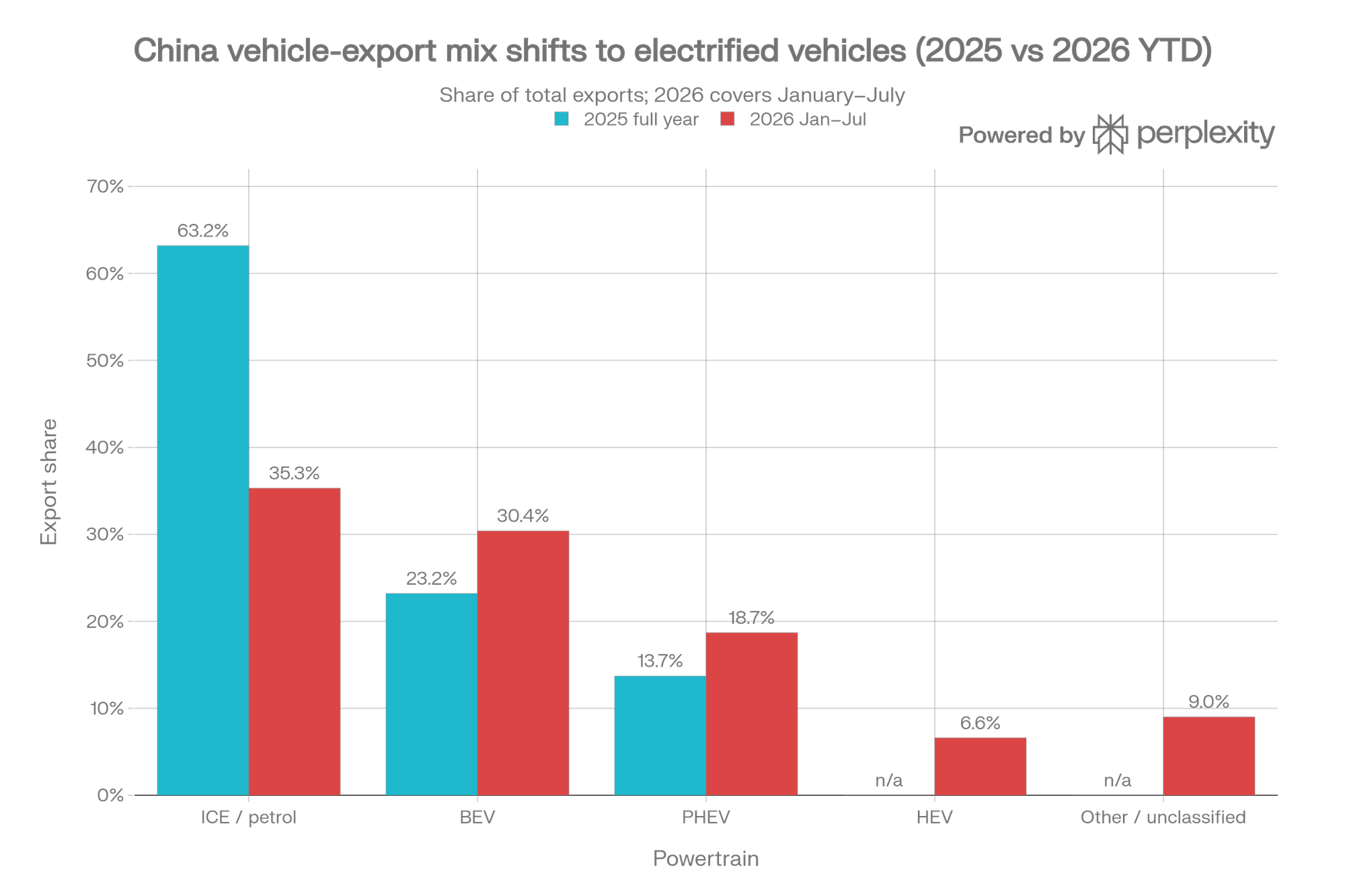
The export mix shows how quickly Chinese manufacturers are adapting. Conventional fuel vehicles accounted for roughly 63% of exports in 2025, versus 23% for BEVs and 14% for PHEVs. By January-July 2026, ICE’s share had fallen to 35%, while BEVs rose to 30%, PHEVs to 19% and HEVs to nearly 7%. Electrified vehicles have moved from a large minority to a clear majority of shipments.
BEVs are the flagship offering in Europe and parts of Southeast Asia, where Chinese brands can compete on price and model range. PHEVs are gaining ground in Latin America and the Middle East, where charging remains patchy and consumers want lower fuel use without range anxiety. Rising HEV exports also point to demand in hybrid-oriented markets, including parts of Southeast Asia.
The next task is to turn shipments into durable overseas businesses through local production, dealer networks, financing and after-sales service. Europe remains the largest developed-market opportunity, although tariffs and political scrutiny will limit growth. The United States is effectively closed, while Japan is likely to remain difficult.
The biggest opportunities over the next five years are likely to be Southeast Asia, Latin America and the Middle East, where demand is growing, Chinese vehicles remain competitively priced and governments are generally more open to Chinese investment and local assembly.
Alerts
EU Tightens Procurement Against China
9 September 2026
The European Commission has proposed “buy European” public-procurement measures designed to favour EU-made goods and services. The initiative is intended to strengthen industrial resilience and respond to concerns that Chinese firms benefit from state support and unequal market access. It signals a further turn toward reciprocal, strategically managed trade in Europe’s economic relationship with China.
Source: https://www.theguardian.com/world/2026/sep/09/eu-buy-european-public-procurement-rules-china-goods-services
Japanese Lawmakers Back Taiwan Cooperation
8 September 2026
A visiting delegation from Japan’s Innovation Party called for closer Japan-Taiwan cooperation to support regional peace and stability. Former party leader Nobuyuki Baba highlighted potential collaboration in drones, space technologies, economic ties, culture, tourism and disaster preparedness. President Lai Ching-te also urged deeper partnership, including more resilient “non-red” democratic supply chains.
Source: https://focustaiwan.tw/politics/202609080027
Australian Envoy Flags China Coercion
9 September 2026
Australia’s new ambassador to Japan warned about China’s expanding missile forces and use of coercive pressure in the region. The comments underline Canberra’s growing alignment with Tokyo on Indo-Pacific security and deterrence. They also place defence cooperation with Japan within Australia’s broader response to China’s military modernisation.
Source: https://asia.nikkei.com/politics/international-relations/australia-s-new-envoy-to-japan-calls-out-china-missile-buildup-and-coercion
Pipeline Price Gap Stalls Talks
9 September 2026
Negotiations on the Power of Siberia 2 pipeline have stalled because China and Russia remain far apart on acceptable gas prices. Sources said China is seeking pricing closer to Russian domestic levels, while Moscow wants a benchmark nearer existing Power of Siberia 1 supply prices. The planned 2,600-km route would carry up to 50 billion cubic metres annually to China via Mongolia, while the sides focus on expanding other supply routes.
Source: https://www.scmp.com/economy/china-economy/article/3366888/power-siberia-2-pipeline-talks-stall-over-china-russia-price-dispute-sources
Japanese Carmakers’ China Sales Slide
9 September 2026
Three major Japanese automakers reported steep year-on-year declines in China vehicle sales in August. The results point to continued pressure from Chinese electric-vehicle producers and intensifying price competition in the world’s largest auto market. Sustained weakness in China would complicate Japanese manufacturers’ efforts to preserve scale and profitability in a strategically critical market.
Source: https://www.nippon.com/en/news/yjj2026090900289U+002f